
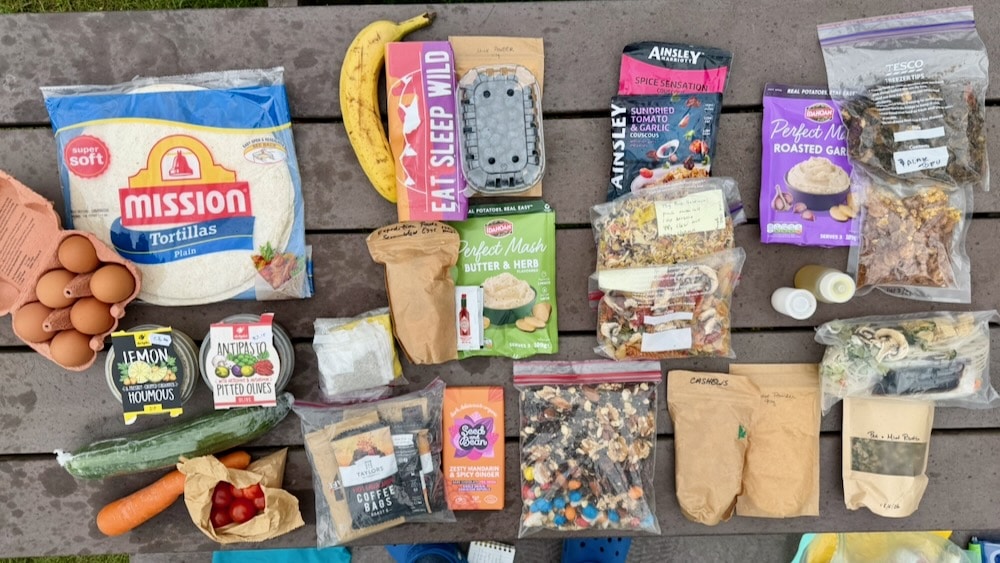
If you dehydrate your own backpacking meals you’ll quickly hit the same question everyone does: what should I actually pack this food in? It’s a bit of a minefield, and each option trades off convenience, cost, and sustainability slightly differently. I’ve thought about this a lot, particularly as one of my motivating factors is the sheer amount of plastic used in commercial backpacking meals – I mean here we are out to enjoy the nature, then bring in all kinds of single use plastic, the stuff that’s destroying the world! My quest for the perfect solution is ongoing, but here’s what I’ve learned so far, and some of it is surprising, especially around bedegradable materials…
TL;DR: How the options compare
| Option | Convenience | Cost | Sustainability | Best for |
|---|---|---|---|---|
| Kraft food pouches | High — resealable zip-top | Low–medium | Good if reused; laminated ones usually aren’t recyclable | Everyday packing, reused several times |
| Vacuum seal pouches (standalone or roll) | Medium — needs a sealer | Low per meal, upfront sealer cost | Good if reused; shrinks with each reuse | Longer trips, bulk batches |
| Mylar bags | Medium — best with heat-seal | Low per bag, moderate all-in | Poor for single use, okay if reused + zip-sealed | Long-term storage, multi-year shelf life |
| Ziplock / freezer bags | High — no equipment needed | Very low | Weakest — least durable, least reusable | Short trips, casual/occasional use |
| Biodegradable/compostable pouches | Medium | Medium | Overstated — usually needs industrial composting; shorter shelf life | Rarely the best choice — see below |
| Bulk storage + decant (jars, mason jar vacuum kits) | Medium — extra step at home | Low ongoing | Best overall — minimal packaging waste per meal | Batch dehydrating, home pantry storage |
The short version: there’s no single “correct” answer, because none of these are plastic-free, and sustainability here is mostly a function of how many times you actually reuse something rather than which material you pick. A reusable option used twice is worse than a single-use one used once. Read on for the reasoning behind each.
What do I use? Pratically, I tend to use boring ol’ zip-lock baggies. They’re light, reusable, cheap, and versatile. While Kraft food bags [currently] make sense for products I sell commercially, zip-lock baggies work perfectly well for the type of food I tend to prep (food that gets used within a few weeks). If I’m prepping meals for longer term, I bulk store them in larger heat-seal pouches.
There’s no plastic-free option — only less-plastic options
Worth saying up front: if you’re eating dehydrated meals on trail, some form of plastic packaging is almost unavoidable. Food safety, weight, and barrier properties against moisture and oxygen aren’t optional out there. So the real question isn’t “how do I avoid plastic,” it’s “how do I get the most use out of the least of it, and where does it go when it’s done.”
Biodegradable or compostable pouches: mostly a myth
These get marketed hard, but the claims don’t hold up well in practice. Most “biodegradable” or “compostable” pouches need industrial composting conditions — sustained heat, moisture, and microbial activity — to actually break down. A landfill won’t provide that, so in practice they often behave exactly like ordinary plastic once discarded, just without the reuse value of something built to last.
There’s a second problem that’s less talked about: these materials generally aren’t as good a barrier against oxygen as true food-grade plastic or mylar, which means dehydrated food stored in them has a shorter shelf life. If you’re relying on these bags for anything beyond a few weeks, that’s worth knowing before you commit a batch of meals to them.
IMPORTANT: Compostable and biodegradable plastics are not recyclable! And often contaminate the recycling process. This happens when consumers get confused with recycling and place the wrong materials in their recycling bin. Like I said, this packaging stuff is a minefield!
Kraft food pouches
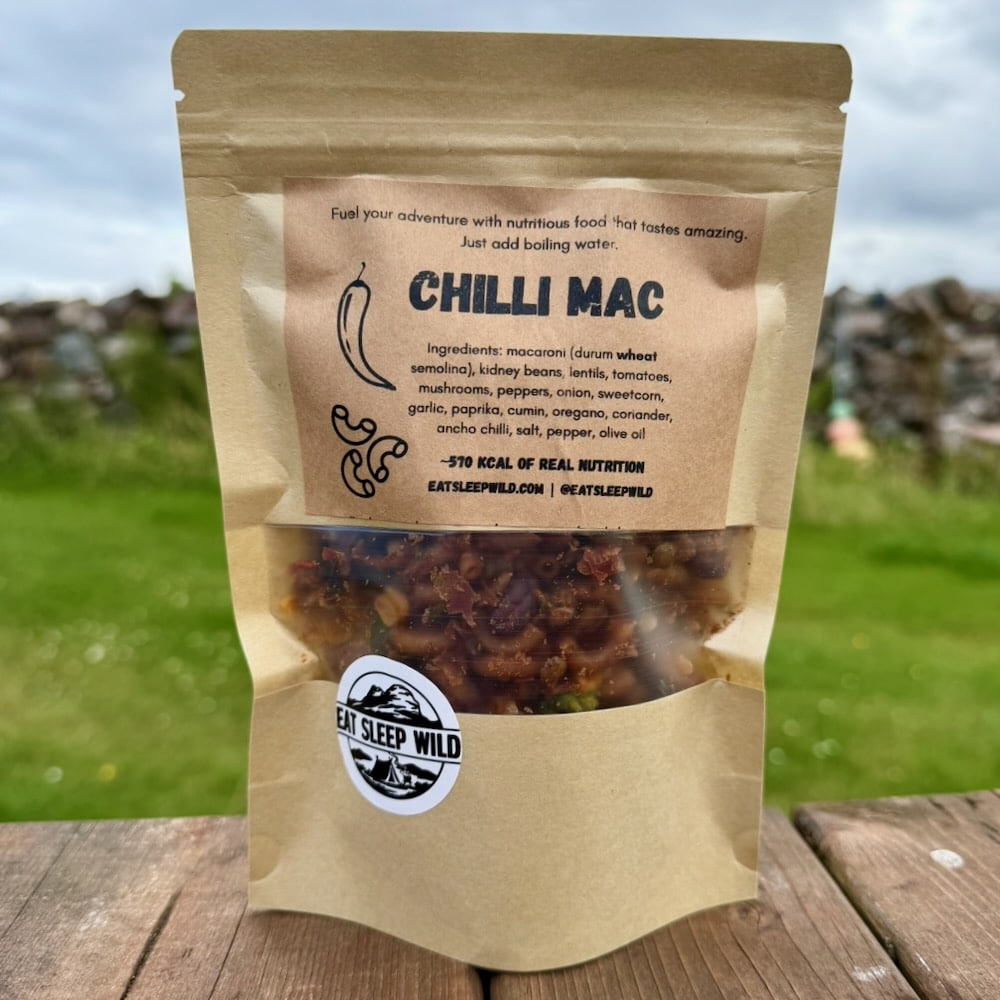
These are my go-to for the packaged foods I sell through my honesty box — food-safe kraft pouches that can be heat-sealed for longer-term storage, but also have a zip-top closure, so they’re resealable and can be reused. I encourage customers to reuse the bags rather than binning them after one use.
But it’s worth being upfront about the caveats. Not all recycling centres accept them: a food-safe kraft pouch is typically kraft paper laminated to a plastic or foil film — that lining is what makes it food-safe and heat-sealable in the first place — and that mixed-material laminate generally can’t be separated by standard recycling equipment. Plain kraft paper bags with no lining are widely curbside recyclable; laminated kraft food pouches usually aren’t. If you’re buying these, reuse is genuinely the better end-of-life plan than assuming they’ll recycle.
I’d love to find a more sustainable option than this, but right now this is the best I’ve found – any suggestions, I’d love to hear them.
For my own personal dehydrated meals, I actually reach for these less often than you’d expect. Most of the time I’m eating what I’ve dried within a week or two of making it, so a reusable ziplock-style bag does the job just as well without needing a heat seal. When I am storing meals longer-term, I bulk-store instead — either in a jar or in a larger kraft food bag or other large sealed pouch — and only portion out into something smaller closer to the trip.
On oxygen absorbers: I’ll admit I went a long time without using these and never had a problem. More recently, packaging meals for my honesty box, I’ve started adding them — mostly as a belt-and-braces move for food that might sit for a while before someone buys it, rather than because I’d had any actual failures without them. If your meals are going straight into your pack for a trip within the next few weeks, you likely don’t need one. If they’re going into longer-term storage, they’re cheap insurance.
Mylar bags → · Oxygen absorbers →
Vacuum seal pouches (standalone or on a roll)
Vacuum sealing solves a specific problem well: it protects food from moisture and oxygen, keeps it organized, and — per Backpacking Chef’s detailed guide to vacuum sealing dehydrated meals — helps seal in food odors (handy in bear country) and slows down mice looking for a midnight snack.
Where people overrate it is the space-saving. I’d echo what David from David on Earth found: the compression from vacuum sealing is genuinely not a big deal — the meaningful benefit is the seal itself, not how flat the bag ends up.
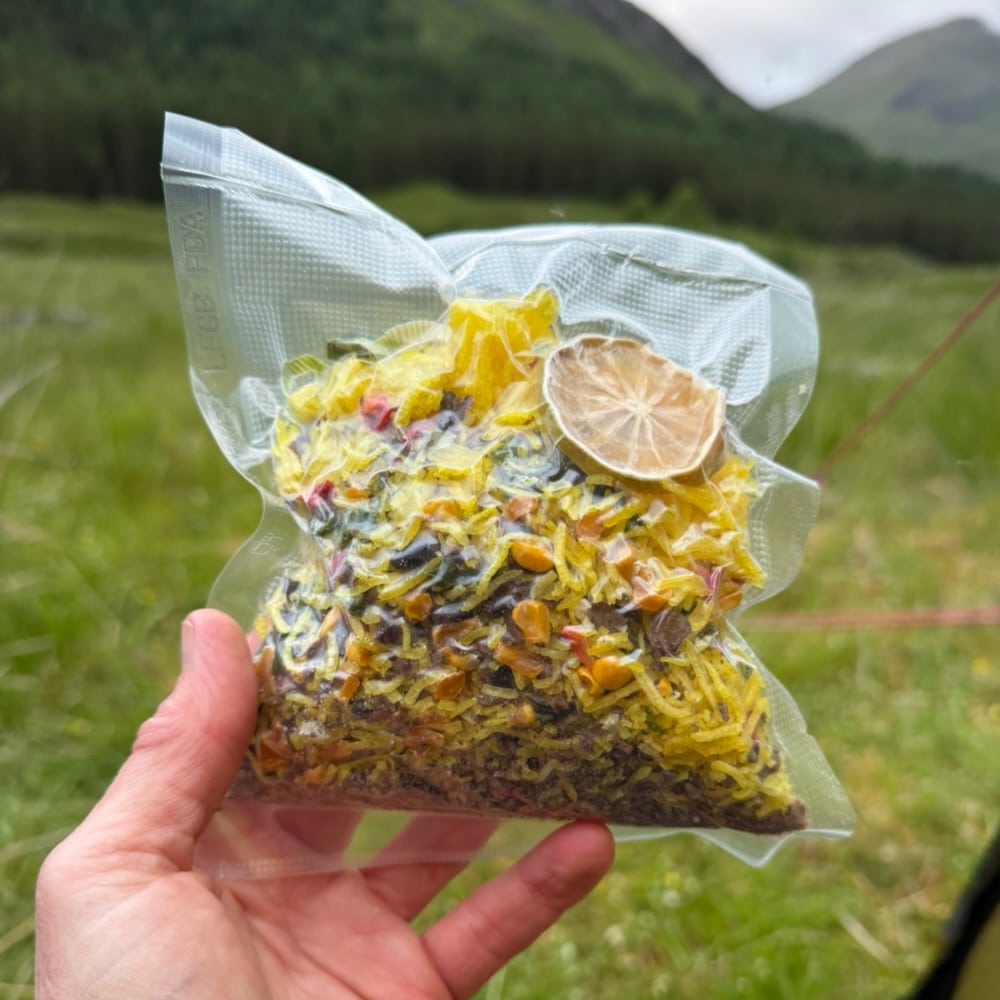
If you’re using pouches sold on a roll (popular for sous vide as well as dehydrated meals), you have an advantage over pre-made pouches: you can leave extra length at the top when sealing, and cut below the original seal line when you open it, which lets you reseal the same pouch again. In my own use, I do reuse these as much as possible — the honest trade-off is that the pouch gets a little smaller each time, since you’re cutting off a fresh section to access the contents. Eventually it’s too short to be useful and gets retired.
For anyone packing meals with sharp or pointy ingredients, Backpacking Chef’s technique of wrapping the meal in a paper towel before sealing is worth doing — it meaningfully cuts down on punctured seals.
Handy side benefit: if you own a vacuum sealer, it’s also useful for resealing food that comes in its own plastic pouch at home — a bag of crisps, for example — so you’re not stuck eating the whole thing in one sitting to avoid it going stale.
Vacuum sealer I use and recommend →
Mylar bags
Mylar comes up constantly for a good reason: it’s a genuinely tough, multi-layer material — an outer polyester layer for puncture resistance, a middle aluminum layer that blocks oxygen, light, and moisture, and a food-safe inner layer that can be heat-sealed airtight. Done properly, this gives dehydrated meals a shelf life measured in years rather than weeks, which is a real step up from a standard freezer bag.
A few honest caveats:
- Heat-sealing needs the right equipment. A basic vacuum sealer often won’t get hot enough to properly seal thicker mylar (7+ mil bags typically need somewhere around 375–425°F). An impulse sealer is usually the better tool for this.
- They’re not easily recyclable in most places, because the aluminum layer that makes them such a good barrier is exactly what most kerbside recycling systems can’t process.
- Reuse is possible but limited. Once opened, you generally can’t re-heat-seal a mylar bag at home. You can still zip it shut and get another use or two out of it — just without the extended shelf life the original heat-seal provided.
Ziplock or freezer bags
The simplest option, and fine for what it is. A decent-quality freezer bag can be reused a handful of times if rinsed and fully air-dried between trips, and needs no equipment at all. What it won’t give you is vacuum compression, strong puncture resistance, or a long shelf life — treat it as the right tool for short trips or occasional use, not for meals you’re storing for months.
Bulk storage + decant
If you’re dehydrating in batches, the most sustainable overall system is usually: store the bulk in something durable and reusable at home — jars, a mason jar vacuum sealing kit, or large mylar — then portion into a smaller rotating set of reusable pouches just before each trip. This keeps packaging waste to a minimum per meal, since you’re not individually sealing everything the day you dry it.
Mason jar vacuum sealer kit for bulk storage →
So what’s actually the “least evil” option?
There isn’t a single winner — it depends on what you’re optimising for:
- Best everyday balance of convenience and reuse: kraft zip-top pouches.
- Best for longer trips or bulk-prepped meals: vacuum sealing, ideally roll-style pouches you can re-cut and reseal repeatedly.
- Best for long-term, multi-year storage: mylar, heat-sealed, with an oxygen absorber if it’s going to sit for a while.
- Lowest cost, no equipment needed: freezer-grade ziplock bags, reused a handful of times, then retired.
- Lowest packaging waste overall: bulk storage at home, decanted into a small rotating set of reusable pouches per trip.
Whatever you land on, all of these eventually reach end of life. When they do, look for soft plastics recycling drop-off points — most major supermarkets now run these — rather than defaulting to landfill. It’s not a perfect system, but making that extra trip with your worn-out pouches probably does more for your footprint than agonising over which brand to buy in the first place.

 French Lentil Salad – Dehydrated Trail Meal – Cold Soak Friendly
Leave a Reply